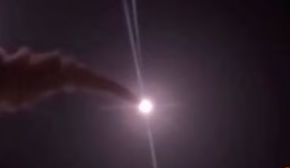

Tensions between the United States and Iran have escalated again after U.S. forces struck two Iranian launchers on Larak Island, prompting Tehran to retaliate against American military bases in the region.
A U.S. official said the strikes targeted two launchers on Larak Island, located near the strategically important Strait of Hormuz. Iranian authorities said two people were killed and several others were injured in the attack.
Iran subsequently launched strikes against two U.S. bases in Jordan, according to Iranian officials.
The renewed military confrontation comes after several weeks in which Washington had increasingly relied on economic sanctions to pressure Tehran rather than direct military action. Diplomatic efforts between the two sides remain stalled.
Iranian President Masoud Pezeshkian said Tehran continues to seek an agreement despite the latest escalation, arguing that an expansion of the conflict would benefit neither Iran nor the wider region.
Pezeshkian said dialogue and cooperation remain the best way to resolve existing disputes and prevent further instability.
TENSIONS RISE OVER STRAIT OF HORMUZ
According to a U.S. official, American forces attacked the launchers after members of Iran’s Islamic Revolutionary Guard Corps were observed preparing equipment linked to the deployment of sea mines in the Strait of Hormuz.
The U.S. military described the operation as a limited and precise action against forces it said posed an imminent threat in the strategically vital waterway.
Larak is a small Iranian island near Bandar Abbas and sits close to the Strait of Hormuz, through which roughly one-fifth of the world’s crude oil shipments normally pass.
The waterway has faced severe disruption since the beginning of the conflict.
Iran also claimed to have attacked Al Minhad Air Base in the United Arab Emirates. UAE authorities denied that the base had been struck, but later said their air force had responded to a drone originating from Iran over Emirati territorial waters.
Iran said its attacks in Jordan targeted U.S. bases that had been used to support the operation against Larak Island.
Iran’s Revolutionary Guards also claimed to have shot down a U.S. drone over Gulf waters.
Meanwhile, Iranian authorities reported that a supertanker caught fire and came to a complete stop after being struck by two naval mines in the southern Strait of Hormuz. Details about the vessel and its crew were not immediately provided.
TRUMP POST SPARKS FURTHER CONTROVERSY
The escalation came after U.S. President Donald Trump posted an AI-generated video depicting massive explosions on Iran’s Kharg Island, accompanied by a message suggesting the island was being destroyed.
Kharg Island is strategically crucial to Iran’s energy sector and handled approximately 90% of the country’s oil exports before the current war.
Iranian oil officials rejected suggestions that the island had suffered a major new attack, saying conditions remained stable and oil operations were continuing.
Workers were reportedly carrying out repairs from previous damage while also upgrading facilities.
WASHINGTON INCREASES ECONOMIC PRESSURE
Alongside military operations, the Trump administration is preparing additional economic measures against Tehran.
U.S. Treasury Secretary Scott Bessent has indicated that new secondary sanctions could be announced on a weekly basis, initially focusing on banks and financial institutions linked to Iran.
The European Union has also said it intends to continue working with the United States and other partners to maintain economic pressure on Tehran.
Despite months of conflict, Washington has yet to fully achieve the objectives it outlined at the beginning of the war, including dismantling Iran’s nuclear program, limiting its ability to strike regional rivals and increasing pressure on the country’s leadership.
The latest military exchanges have renewed concerns that the conflict could widen further, particularly around the Strait of Hormuz, one of the world’s most important routes for global energy supplies.