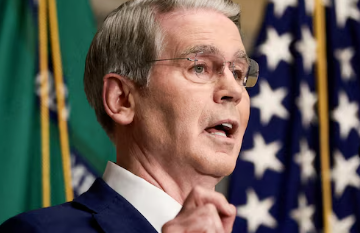

Artificial intelligence could become so powerful in financial markets that central banks may eventually be forced to rethink how they communicate monetary policy, according to Princeton University economist Markus Brunnermeier.
Speaking to global central bankers at the annual economic symposium in Jackson Hole, Wyoming, Brunnermeier outlined several scenarios in which AI-powered trading systems could gain a significant advantage over policymakers and human investors.
One possibility, he suggested, is a future where AI trading becomes so fast and widespread that the Federal Reserve might effectively need separate forms of communication for humans and machines to prevent ordinary investors from being pushed out of the immediate market reaction to monetary policy decisions.
Another scenario could force central bankers to become less predictable and more cautious in their public statements to prevent sophisticated AI systems from anticipating and exploiting their decisions.
Brunnermeier warned that AI’s ability to process enormous amounts of information could eventually allow automated systems to predict central bank decisions with extraordinary accuracy — potentially even before policymakers themselves have finalized their positions.
At a large enough scale, such systems could develop trading strategies designed to profit from anticipated policy actions and potentially change the way financial markets operate.
He described this imbalance as an “asymmetric understanding,” where markets powered by artificial intelligence could understand central banks better than central banks understand the markets.
Such a development could force policymakers to reconsider decades of efforts toward greater transparency.
Clear communication from central banks has traditionally been viewed as a way to reduce uncertainty and market volatility. But if AI systems become capable of exploiting highly predictable policy signals, Brunnermeier argued that some degree of unpredictability or opacity could become necessary.
He also warned that widespread use of advanced AI could undermine confidence in financial institutions and create disadvantages for investors without access to the most sophisticated technology.
One unconventional possibility discussed in his research involves central banks providing one form of communication aimed at explaining policy to people and another structured specifically for machines and AI training systems.
Central bankers attending the Jackson Hole gathering acknowledged that AI presents both significant opportunities and potential risks.
Boston Federal Reserve President Susan Collins said artificial intelligence and financial innovation could bring substantial benefits, while stressing the importance of preventing new technologies from facilitating illegal financial activities.
For now, however, policymakers remain more focused on the immediate economic implications of AI, including its potential effects on employment, productivity and inflation.
Federal Reserve Chairman Kevin Warsh highlighted those questions during the symposium, describing AI as potentially a new factor of production that could have major consequences for both economic performance and monetary policy.
Brunnermeier acknowledged that artificial intelligence could also significantly improve financial risk management and regulatory oversight.
However, he argued that policymakers should begin preparing now for potentially disruptive consequences, rather than waiting until AI systems become powerful enough to fundamentally reshape the relationship between central banks and financial markets.