
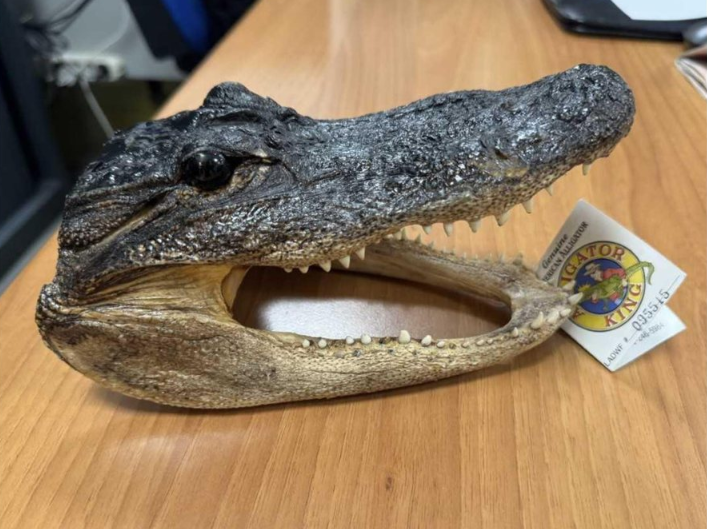

An Italian traveler returning from the United States is under investigation after customs officers at Turin Airport discovered the head of a protected crocodile species hidden inside his luggage.
The passenger had traveled from Miami to Turin via Istanbul when authorities made the unusual discovery during an inspection. The reptile’s head had been wrapped in thick brown paper and concealed among the traveler’s belongings.
Border officials immediately confiscated it, while the man, who was reportedly returning from vacation, was placed under investigation for allegedly attempting to illegally import a specimen belonging to a protected species.
International trade involving crocodiles is strictly regulated under the Convention on International Trade in Endangered Species of Wild Fauna and Flora (CITES), which was established to protect vulnerable wildlife from exploitation through international commerce.
Italian authorities said the crocodile head had entered the country without the required certificate or import permit.
If convicted, the traveler could face a fine ranging from €20,000 to €200,000. A prison sentence of between six months and one year is also possible under Italian law.
The seizure is part of a broader effort by Italian authorities to combat the illegal wildlife trade, a lucrative international business involving everything from reptiles and exotic birds to turtles and primates.
Italy is considered an important transit point for some forms of illegal wildlife trafficking. Investigations have also increasingly focused on online sales and cross-border networks used to trade protected animals and animal products.
Authorities have warned that tourists can also become involved without fully understanding the law. Items such as preserved crocodile heads are sometimes sold as souvenirs abroad, but taking them across international borders without the necessary documentation can result in seizure, heavy fines and criminal charges.




