
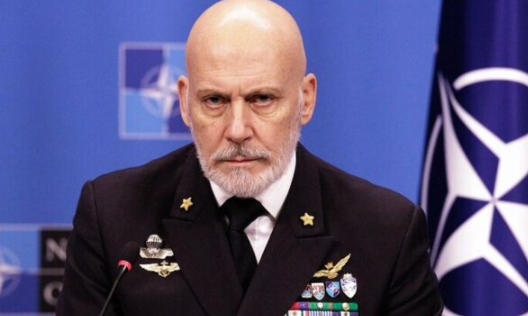

NATO is prepared to defend “every inch” of Allied territory amid growing pressure from Russia, Admiral Giuseppe Cavo Dragone, Chair of the NATO Military Committee, said following a meeting of the Alliance’s Chiefs of Defence in Copenhagen.
Cavo Dragone said that while no NATO member has been subjected to an attack triggering Article 5, the current security environment cannot be described as entirely peaceful.
He said Russia’s airspace violations, drone incidents and hybrid activities are testing the determination of NATO members. He also described Russian propaganda as a major concern, arguing that it seeks to influence democratic processes and undermine unity among Western countries.
Cavo Dragone stressed that NATO remains prepared for a range of scenarios, while highlighting the importance of national resilience, critical infrastructure and rapid responses to hybrid threats.
On defence spending, he said European NATO members and Canada have significantly increased military investment, while urging the defence industry to accelerate the delivery of equipment and capabilities.
The admiral also addressed the possibility of an Article 5 response, noting that collective defence is not automatic and that decisions are made collectively by NATO members. He pointed to Article 4, which allows an Ally to request consultations when its security is threatened, as well as Article 3, which focuses on national resilience.
Cavo Dragone highlighted Finland and Sweden as examples of countries where national security involves not only the armed forces but society as a whole, including infrastructure and the private sector.
He also discussed the difficulties of moving military personnel and equipment across European borders, calling for harmonized rules, faster authorization procedures, emergency mechanisms and dedicated military corridors.
On artificial intelligence, Cavo Dragone said the biggest challenge is the speed at which threats develop and the time required to respond. He said AI can be used for tasks such as data processing and defence-related automation, but emphasized that human beings must remain responsible for decision-making.
“The time between when something happens and when we respond is a decisive factor today,” he said.
Cavo Dragone is due to leave his position in summer 2027, when German General Carsten Breuer is scheduled to take over as Chair of the NATO Military Committee.




