
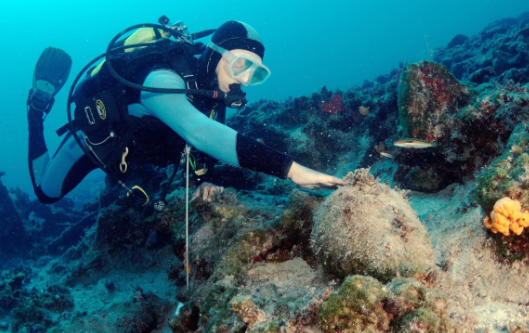

Archaeologists believe they may have discovered the world’s oldest shipwreck off the coast of Turkey, estimating that it dates back between 4,400 and 4,700 years, to the Early Bronze Age — roughly the same period when the Great Pyramid of Giza was built in Egypt.
Although the ship’s wooden structure has not survived, archaeologists have recovered amphorae, ceramic storage vessels carried by the vessel, from the seabed. Some of the containers still hold traces of their original contents.
The researchers who discovered the wreck believe the vessel was approximately 10 metres long and transported goods across the Mediterranean. Divers brought the amphorae to the surface, where they are now being carefully preserved after thousands of years underwater.
“The shipwreck is like a time capsule on the seabed,” said Professor Hakan Öniz of Turkey’s Akdeniz University, who led the expedition organised by the Mediterranean Archaeological Association.
The remains were discovered off the coast of Kekova Island in Turkey’s Antalya province. Artefacts are scattered along an underwater slope at a depth of just 30 metres. The team also found three large stone anchors and more than 30 amphorae.
Because no part of the ship’s wooden structure survived, radiocarbon dating — a method that measures a specific form of carbon in organic materials — cannot be used to establish its age.
Instead, archaeologists analysed the shape and design of the amphorae. Ceramic styles evolved over time, allowing researchers to associate particular vessel types with specific historical periods.
The pottery found at Kekova has distinctive features, including two handles, a raised ridge around the middle and a flat base.
Öniz said the design matches amphorae discovered in Egypt and the Middle East that are known to be between 4,400 and 4,700 years old.
“By comparing the decorative techniques, we can say with 100 per cent certainty that our wreck dates to the Early Bronze Age,” he said.




