
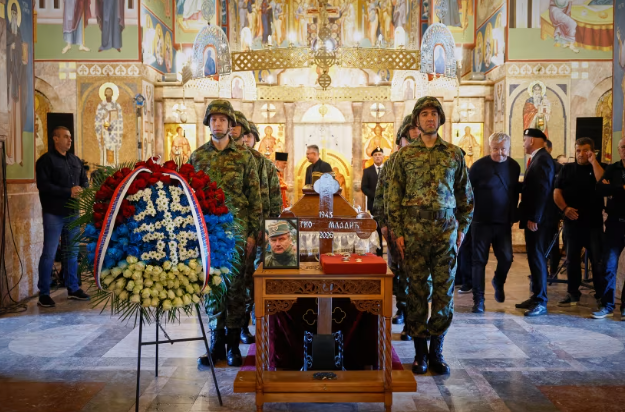

The body of convicted Bosnian Serb war criminal Ratko Mladić lay in state in Belgrade on Monday, as thousands gathered to pay tribute ahead of his funeral despite strong criticism from European officials.
Mladić, the former Bosnian Serb military commander, died at the age of 84 on August 27 in The Hague while serving a life sentence for genocide, war crimes and crimes against humanity committed by forces under his command during the 1992–1995 Bosnian war.
Mourners began arriving early at the Serbian Orthodox Church of St. Luke in Belgrade. Mladić’s military cap and saber were placed on his coffin, while men dressed in military-style fatigues stood nearby.
The funeral arrangements were formally organized by Mladić’s family, but Serbian authorities sent a plane to transport his remains from the Netherlands to Belgrade. Soldiers carried his coffin, which was draped in the Serbian national flag, and a military commemoration was held at an official Serbian army venue on Saturday.
Serbian media reported that Mladić would receive full military honors, while Serbian Orthodox Patriarch Porfirije was expected to lead the funeral service.
Serbian President Aleksandar Vučić, who is not attending the funeral, described the public response to Mladić’s death as an “emotional outpouring” and rejected suggestions that the government was responsible for allowing the tributes.
The events have triggered criticism from the European Union and officials across the region. Serbia is an EU candidate country, and European Enlargement Commissioner Marta Kos canceled a planned visit to Serbia, arguing that the glorification surrounding Mladić’s death was incompatible with the values expected of countries seeking EU membership.
Mladić was sentenced in 2017 for crimes that included the 1995 Srebrenica genocide, in which more than 8,000 Bosniak Muslim men and boys were killed. He was also convicted over the prolonged siege of Sarajevo and other crimes committed during the Bosnian war.
The conflict left more than 100,000 people dead and displaced more than one million before ending in 1995 with a U.S.-brokered peace agreement.
Since Mladić’s death, supporters have organized vigils and painted murals bearing his image in Belgrade. At a football match on Sunday, fans displayed a large image of the former commander and chanted his name.
Serbia has continued to reject the classification of the Srebrenica massacre as genocide, while describing it as a horrific crime.
The tributes to Mladić have renewed controversy over Serbia’s approach to its wartime past at a time when its path toward European Union membership has already faced significant obstacles.




