
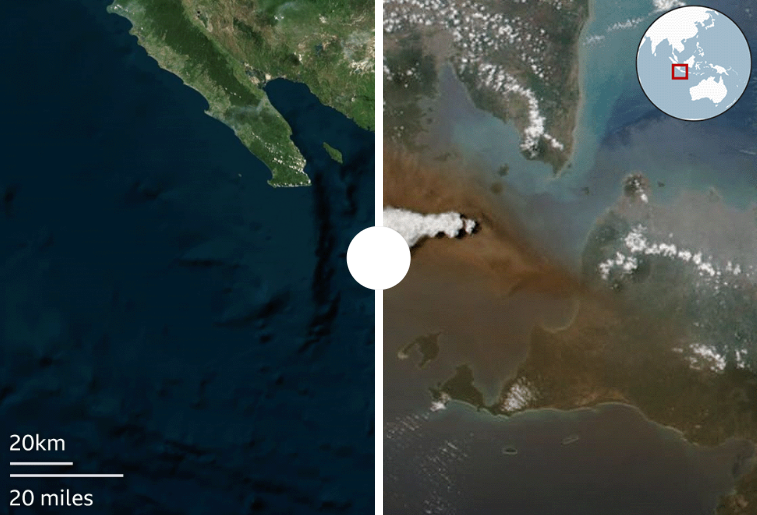

Around 270,000 passengers have been stranded across Indonesia after the eruption of Anak Krakatau forced the cancellation or grounding of more than 2,000 flights and prompted several airports to suspend operations for a second consecutive day.
The volcano, located about 150 kilometers (90 miles) from Jakarta, began erupting late Friday, producing lava fountains and sending large amounts of volcanic ash toward the Indonesian capital and Lampung province. Seismic activity continued throughout the weekend.
Jakarta’s Soekarno-Hatta International Airport and three other airports extended their closures until 6 p.m. local time Monday after volcanic ash was detected in nearby airspace.
The disruption has caused major congestion at airports, with long lines of passengers seeking refunds, alternative flights and information about when operations could resume. Some travelers have turned to trains and other forms of transportation after repeated flight delays and cancellations.
The eruption has affected more than air travel. Schools in impacted areas moved classes online, while some shipping operations were also disrupted.
Indonesia’s Geological Agency warned Monday that the possibility of further eruptions remains high. Volcanic ash reportedly reached altitudes of around 6,000 meters on the Java side of the volcano and as high as 15,000 meters on the Sumatra side and parts of Banten province.
The latest eruption was recorded Sunday evening, while authorities said changing weather conditions made it difficult to determine when airport operations could safely return to normal. Officials have been conducting frequent tests to monitor whether the volcanic ash cloud is expanding or beginning to clear.
Authorities have prohibited people from approaching within three kilometers of the active crater. Ships traveling through the Sunda Strait have also been ordered to stay outside a three-kilometer exclusion zone.
Officials said there is currently no tsunami warning associated with the volcano’s latest activity.
Anak Krakatau, meaning “Child of Krakatoa,” emerged from the sea in the volcanic caldera created following the catastrophic 1883 eruption of Krakatoa. It has remained periodically active ever since.
In December 2018, part of Anak Krakatau collapsed, triggering a devastating tsunami that killed more than 400 people and left thousands injured or displaced along the coastlines of Java and Sumatra.
Indonesia sits along the Pacific Ring of Fire, one of the world’s most volcanically and seismically active regions.




