
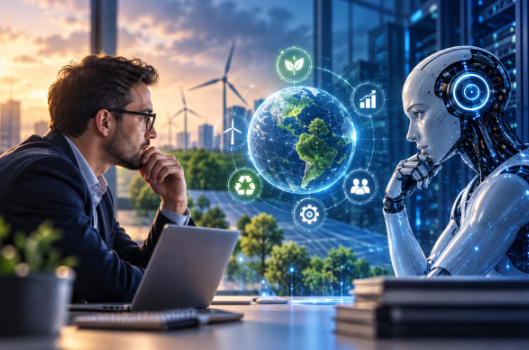

Speaking at the “PRIME” conference, held under the theme “Two Steps Forward and No Stepping Back,” Dominik Kanbach discussed the impact of artificial intelligence on digital transformation and the challenges it poses for sustainability.
Kanbach emphasized that many companies still lack clarity about how they intend to use artificial intelligence, while also raising concerns about the growing energy consumption associated with emerging technologies.
Kanbach: Companies Must Balance Artificial Intelligence and Sustainability
“Companies often do not really know what they want to use artificial intelligence for. There is a heavily criticized study claiming that 95% of generative AI projects fail to create value. I am not endorsing that figure, but what I can say is that companies often lack clarity about what they want to achieve with these technologies,” he said.
Kanbach noted that an analysis of hundreds of cases worldwide had found no clear connection between artificial intelligence projects and sustainability initiatives.
He also highlighted the impact of AI on energy consumption and emissions among major technology companies.
Kanbach: AI-Generated Work Can Be Poorly Designed and Reduce Quality
“Google’s environmental report shows that the energy required for a single Gemini prompt has decreased 33-fold, while emissions per prompt have fallen by 44% over the past year. At the same time, however, overall energy consumption has increased by 37%, largely due to artificial intelligence,” he said.
According to Kanbach, these figures demonstrate that digital transformation cannot be considered separately from the realities of today’s workplace, as the growing use of technology also creates new environmental challenges.
He also addressed AI’s impact on the workforce, noting that while its use can increase speed and productivity, it does not necessarily improve quality.
“We need to train people to exercise sound judgment and critical thinking so they can evaluate the results produced by artificial intelligence. AI-generated work can be poorly designed and can reduce quality,” he said.
Kanbach stressed that the main challenge is not simply determining whether artificial intelligence will lead to a negative scenario, but deciding how much human involvement should remain in the decision-making process.
According to him, companies must strike a balance between digital transformation and sustainability, taking into account rising energy consumption and emissions.
Concluding his remarks, he reiterated the message “Two Steps Forward and No Stepping Back,” describing it not merely as a reflection of the current situation but as a responsibility for the future and for how artificial intelligence will be used.




