
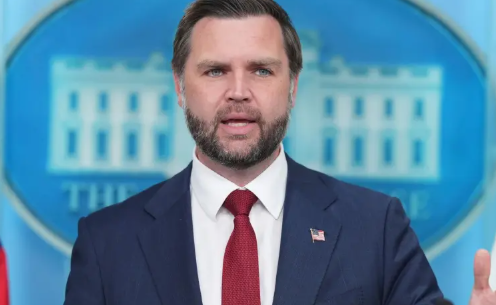

U.S. Vice President JD Vance has rejected describing the ongoing military confrontation with Iran as a “war,” while declining to predict whether the six-month conflict will end before November’s U.S. midterm elections.
Speaking at a White House briefing, Vance said he did not want to impose an artificial timeline on the conflict, arguing that its duration largely depends on whether Iran continues targeting commercial vessels.
His comments came despite continued military tensions in the Gulf, including an Iranian attack targeting Kuwait following a new round of U.S. strikes against Iran earlier in the week.
Vance defended the latest American military action, saying Washington had a responsibility to respond to Iranian threats against commercial shipping through the strategically important Strait of Hormuz.
CONFLICT BECOMES POLITICAL ISSUE AHEAD OF MIDTERMS
The prolonged confrontation is becoming an increasingly difficult political issue for President Donald Trump’s administration ahead of the November 3 congressional elections, when Republicans will seek to defend their narrow majorities.
The conflict has lasted far longer than initially suggested by the White House and has contributed to higher energy costs and inflationary pressure on American consumers.
Vance refused to predict when hostilities could end, saying Washington could not determine when Iran would stop attacking ships.
The administration has also faced scrutiny over how U.S. military casualties from the conflict have been classified.
Four American soldiers killed and dozens of troops wounded after a ceasefire collapsed were later moved into a Pentagon casualty category called “Overseas Operations” after initially being included in conflict-related totals.
OIL PRICES REMAIN FAR ABOVE PRE-CONFLICT LEVELS
Energy markets remain one of the biggest economic consequences of the confrontation.
International benchmark Brent crude was trading above $95 per barrel on Thursday, compared with roughly $72 per barrel immediately before the conflict began.
The Trump administration says the U.S. Navy has significantly increased the amount of Gulf oil moving through the Strait of Hormuz.
Vance said approximately 15 million barrels of oil were escorted through the waterway on Wednesday, while Energy Secretary Chris Wright said around 17 million barrels passed through with U.S. Navy assistance on Monday.
Before the conflict, roughly 20 million barrels of Gulf oil moved through the strait each day.
Independent shipping data, however, indicates that overall vessel traffic remains substantially below pre-conflict levels.
Over the past 28 days, an average of approximately 5 million barrels of oil per day has exited through the strait, according to one tanker-tracking estimate, while other assessments have ranged between 2 million and 6 million barrels daily.
TRUMP BALANCES MILITARY AND ECONOMIC PRESSURE
Washington has adopted a strategy combining economic sanctions with the possibility of additional military action as Iran continues resisting U.S. pressure.
The Trump administration maintains that its campaign has severely weakened Iran’s naval and air capabilities.
Iranian officials have estimated that the country has suffered approximately $270 billion in direct and indirect economic damage during the conflict.
Despite those losses, Tehran has retained leverage through attacks around the Strait of Hormuz and against U.S. allies in the Gulf.
Washington is simultaneously looking at ways to reduce the global energy market’s dependence on the strategic waterway.
Treasury Secretary Scott Bessent has argued that planned regional pipelines could dramatically reduce the Strait of Hormuz’s importance within the next two years.
Iran and Oman, meanwhile, have discussed a phased arrangement for jointly managing maritime traffic through the strait.
NO QUICK END TO THE STANDOFF
Analysts say neither Washington nor Tehran currently appears willing to make the concessions necessary for a major breakthrough.
The Trump administration faces pressure to avoid another large-scale escalation while also avoiding an agreement that could be portrayed as giving Iran renewed control over the Strait of Hormuz.
With the U.S. midterm elections approaching, Washington could remain in a holding pattern — maintaining economic and military pressure on Tehran without returning to an intense bombing campaign or making significant concessions.
For now, the six-month confrontation remains unresolved, while its impact continues to be felt across global energy markets and increasingly in U.S. domestic politics.




