
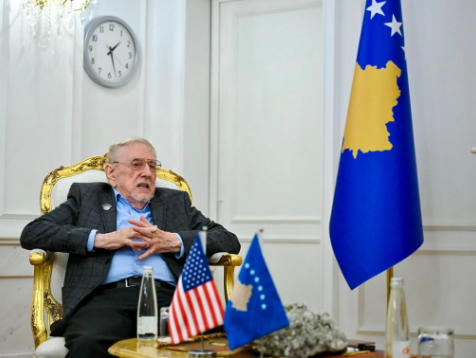

Retired U.S. diplomat William Walker has spoken ahead of the September 16 verdict in the Hague trial involving former Kosovo Liberation Army (KLA) leaders, saying he is anxiously awaiting the decision after what he described as an exceptionally lengthy judicial process.
“I’m waiting with great anxiety after a very, very long process. I cannot imagine how Hashim Thaçi, Kadri Veseli and Jakup Krasniqi must feel after spending so much time in detention. I simply cannot understand why the process has taken so long,” Walker said.
The former head of the OSCE Verification Mission in Kosovo criticized the prosecution’s approach, arguing that the case was built on what he considers flawed assumptions about the structure of the KLA.
Walker said the prosecution had portrayed the KLA as a conventional, highly organized military force with a centralized chain of command leading directly to the three defendants. In his view, the KLA was instead a more decentralized organization made up of different regional commanders.
“I believe the prosecution relied on some false premises by presenting the KLA as a standard army with a chain of command reaching these three men. I know the KLA was very different from that. It was a regional organization with different regional commanders,” Walker said.
Walker Questions the Trial Process
Walker went further, arguing that the proceedings themselves had failed to deliver justice and claiming that the defendants’ lives had already been severely affected by years of pre-trial detention.
“Whatever the verdict, I believe the investigation and trial over alleged war crimes committed by these three people has been a farce. The court has operated on a complete misunderstanding of what the KLA was,” he said.
Walker emphasized that he has always supported the principle that a person should be considered innocent until proven guilty by a final court decision.
“I have always believed that justice is based on the principle that you are innocent until proven guilty, and that you should not be imprisoned until a verdict has been determined,” he said, adding that he was deeply troubled by what he described as the injustice of the process.
“I Don’t Know What the Verdict Will Be”
Walker said he has no information about what the final ruling will be and that even people he has spoken with do not know what decision the court may reach.
Regardless of whether the defendants are found guilty or acquitted, he said he believes the process itself deserves criticism. Walker also argued that the proceedings have harmed Kosovo’s international image and expressed hope that the people of Kosovo would view the trial as having a significant political dimension.
He said he regretted the impact of the proceedings not only on the defendants but also on Kosovo, describing the country as a young democracy that has worked to demonstrate its progress after decades of conflict and instability.
Walker concluded by saying that, in his view, the Hague proceedings represented more than a search for justice and truth, and that the political implications of the process should not be overlooked.




